Showing posts with label Disasters. Show all posts

Sunday, October 23, 2011

At Least 75 Killed, Many More Trapped and Injured After Magnitude 7.2 Quake Rocks Eastern Turkey

AFP Photo
At least 75 people were reported killed and many more feared trapped in collapsed buildings after a magnitude 7.2 earthquake jolted the mountainous province of Van in southeastern Turkey on Sunday.
Up to 30 buildings collapsed in Ercis, including a dormitory, and 10 buildings collapsed in Van, Deputy Prime Minister Besir Atalay said.

Rescuers in Ercis scrambled to find survivors in a flattened eight-story building that had shops on the ground floor, television footage showed. Residents sobbed outside the ruins, hoping that missing relatives would be rescued.

"My wife and child are inside! My 4-month-old baby is inside!" CNN-Turk television showed one young man crying.

Witnesses said eight people were rescued from the rubble, but frequent aftershocks were hampering search efforts, CNN-Turk reported.

"There are so many dead. Several buildings have collapsed. There is too much destruction," Zulfikar Arapoglu, the mayor of Ercis, told NTV television. "We need urgent aid. We need medics."

The quake's epicenter was in the village of Tabanli, 10 miles from Van.
Between the aftershocks and the number of people feared trapped in some of the collapsed buildings, the death toll is expected to rise. Authorities had no word on damages or casualties from the remote villages in the region, but local officials beginning to assess damage via helicopter.

Saturday, October 22, 2011

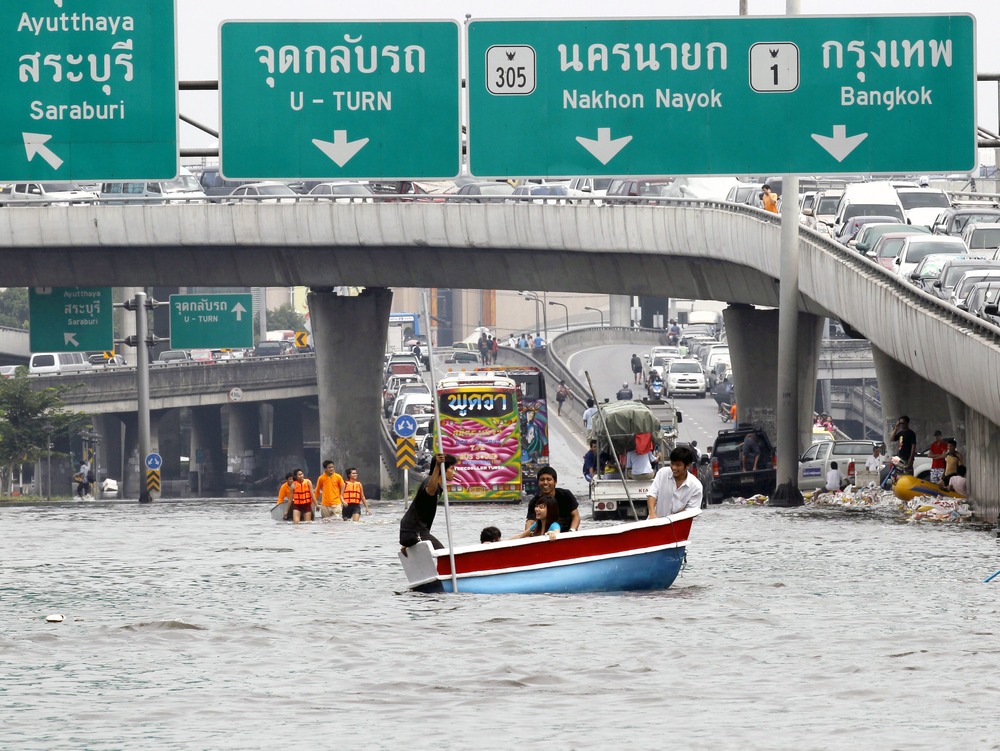
Rising Thai Floodwaters Reach Bangkok

Flooded highway interchange at Pathum Thani north of Bangkok on October 20
Knee high floodwaters began inundating outlying sections and neighborhoods of the Thai capital this week as officials warned resident to move their belongings to higher ground.
Knee-high floods began to appear in some outer districts of the city, a day after authorities said they would take the risky move of releasing some waters that had been building up in recent days behind barricades fashioned along the city's northern outskirts. The idea is to let some waters run through the canals that crisscross Bangkok to escape to the sea, but it was unknown whether the operation could be executed without inundating large parts of the capital.

In Thailand, more than 200 major highways and roads are now impassable, while several key industrial estates have been inundated. Damages are expected to tally at least $6 billion and shave up to two percentage points off gross domestic product, according to economists' estimates. Humanitarian groups said parts of the affected provinces-- covering about a third of Thailand -- are inaccessible, with some towns under water more than six feet high.
There are several industrial parks around Bangkok that provide components for products from companies such as Toyota [NYSE: TM], Apple Computers [NASDAQ: AAPL] , Honda Motors [NYSE: HMC] and Sony [NYSE: SNE] that have halted production at their Thai facilities due to the ongoing flooding, further disrupting supply chains already in disarray from the March 2011 quake and tsunami that struck Japan.


State Railways of Thailand (SRT) passenger tran traversing flooded are near Phra Nakhon Si Ayutthaya, Thailand on October 19, 2011. Lerdchai Seangsong photo


Some of the expressways in and out of the capital had literally become parking lots as the high overpasses were the only high ground that the motorists were able to find. Thai Prime Minister Yingluck Shinawatra and over government officials have warned that the floodwaters could take as long as 6 weeks to fully receede.
Earlier this month, the Kingdom's State Railway of Thailand shut down freight and passenger service to two northern cities while more recently it offered tourists refunds on tickets rendered unusable due to suspension of service because of the floods.

Thursday, September 8, 2011

As Texas Burns, Contract Dispute Grounds Firefighting Aircraft in California


A contract dispute with a California aviation company is keeping close to half the US Government's firefighting aircraft idle on the tarmac thousands of miles from fast-moving wildfires in Texas that have killed at least two people, scored more than 100,000 acres and destroyed nearly 1400 homes in the Lone Star state.

The U.S. Forest Service terminated the contract with Aero Union five weeks ago to operate seven P-3 Orions that are critical to the agency’s firefighting mission, leaving the federal government with 11 tankers under contract to help battle more than 50 large uncontained wildfires now burning nationwide.

That’s down from 40 tankers used by the Forest Service just a decade ago, according to Rep. Dan Lungren (R.-Calif.), chairman of the House Committee on Administration, who is challenging the decision to dismiss the largest provider of heavy air-tanker support to the federal government.

“We were certified to fly all season, but they just terminated us and threw 60 people out of work and left the country vulnerable to fires, as you can see right now in Texas,” said Britt Gourley, CEO for Aero Union.

“This is our 50th anniversary fighting fires for the Forest Service. It’s not quite the way we wanted to celebrate it,” Gourley said.

Gourley said the government did not provide details on why the contract was canceled, but that they did not agree with Aero Union’s 15-year maintenance plan.

“We wanted to sit down with them and ask why it was canceled and find a quick resolution, but they didn’t want to talk about it. They just said, ‘We don’t want the airplanes, have a nice life,’ ” Gourley said. “I had to let go of my staff–60 people and their families were devastated,” Gourley said. “It’s really been tragic.”

The Forest Service says it will not use aircraft that does not meet its requirements, and in this case that included the long-term airworthiness inspection program, although the company passed its annual inspection.

“Our main priority is protecting and saving lives, and we can’t in good conscience maintain an aviation contract where we feel lives may be put at risk due to inadequate safety practices,” said Tom Harbour, director of the Forest Services fire and aviation management program.

“This contract termination notwithstanding, we possess the aircraft support needed for this year’s fire season,” Harbour said.
The California-based comany has been in dire financial straights since the cancellation of the US Forest Service contract, missing their first lease payment on their space at the Chico, CA airport and had to lay off 60 employees.

In April 2011, the US State Department requested the use of two specially equipped C-130 cargo planes from the US Air Force Reserve's 302nd Airlift Wing in Peterson AFB, Colorado to combat wildfires in the northern Mexican state of Coahuila. Contrast that with taking nearly two months for any kind of federal disaster declaration from the Obama Administration when those same fires jumped the border and burned thousands and thousands of acres in west Texas.

Firefighters had made inroads Wednesday against the most destructive of the nearly two dozen wildfires that have scorched the Lone Star state since Labor Day weekend. The Bartsop county complex fire, just east of the state capital of Austin, has scorched at least 34,000 acres and nearly 500 homes and is thought to have killed two people as of Thursday.

Texas Gov. Rick Perry, who announced his presidential bid last month, cut short campaigning in South Carolina and help a new conference in Barstop on Monday after being briefed by public safety officials (although he did attend Wednesday night's televised GOP debate at the Reagan Library in Simi Valley, CA).

Other wildfires in Texas include a 7000 acre fire southeast of spicewood and a 150 acre fire in Travis County that's burned 25 homes.

Thursday, August 18, 2011

Magnitude 6.8 Earthquake Strikes Off Shore of Northeastern Japan; Money Continues Washing Ashore After Deadly March Tsunami

Japan's Meteorological Agency is reporting a quake with a preliminary magnitude of 6.8 struck the northeast coast of Japan.


A tsunami warning was issued by the agency for the Miyagi and Fukushima prefectures on Friday morning, but the advisory was lifted about a half hour later.


Tokyo Electric Power Co reported that there were no abnormalities and that key equipment in the stricken Fukushima Daiichi nuclear power plant continued operating normally while key employees positioned outside were evacuated as a precaution.


Interestingly, nearly 6 months after the devastating March 11 earthquake and tsunami which is thought to have killed at least 20,000 people in Northeastern Japan, survivors and volunteers have turned over to the authorities the equivalent of nearly US$80 million in cash that has washed up on shore or in the ruins of homes and apartments.
In the five months since the disaster struck, people have turned in thousands of wallets found in the debris, containing $48 million in cash.


More than 5,700 safes that washed ashore along Japan's tsunami-ravaged coast have also been hauled to police centers by volunteers and search and rescue crews. Inside those safes officials found $30 million in cash. One safe alone, contained the equivalent of $1 million.


The National Police Agency says nearly all the valuables found in the three hardest hit prefectures, have been returned to their owners.


"In most cases, the keyholes on these safes were filled with mud," said Koetsu Saiki with the Miyagi Prefectural Police. "We had to start by cutting apart the metal doors with grinders and other tools."


Determining who the safes belonged to, proved to be the easy part. Saiki says most kept bankbooks or land rights documents inside the boxes, containing their names and address. Tracking the owners down, was much more challenging.
With some police stations running out of room in their lost property areas, police are attempting to cross reference names and phone numbers documents found in safes and lockboxes with survivors of the quake and hoping to track down what shelter they were staying in.


Keeping cash at hand is fairly common practice in Japan, as many Japanese prefer to keep their money at home. A police spokesman explained that the number of boxes and safes that have been recovered seems especially high because many fishing companies in northeastern Japan also prefer to do business and pay employees in cash.

Wednesday, May 25, 2011

More Tornadoes, Deadly Storms Continue to Hammer Midwest


NOAA Map Showing Tracks of Tornadoes Across Oklahoma earlier this week
Just days after a massive F5 tornado ripped through downtown Joplin, MO at least a half dozen tornadoes carved a swath of destruction throughout northern and central Oklahoma.

While not as severe or deadly as Sunday's Joplin F5 twister or the outbreak of storms that hit the South last month, at least 10 people were killed making it the deadliest in the state since an F5 struck suburban Oklahoma City in May 1999, killing 50.

Side by side satellite images of Joplin, MO before and after F5 tornado- AP
There were concerns that a storm system moving through the area could spawn additional tornadoes as rescuers were still searching wreckage throughout Newton County, but as of Thursday night, there were no additional tornadoes reported in the area.

However, rescue workers are still searching for at least 232 people still unaccounted for since Sunday's disaster and the death toll had been revised up to 125. Nearly half of the missing are said to be seniors.

For those interested in making any kind of donation towards disaster relief in Southwestern Missouri, more information can be found at the Heart of Missouri United Way, Ozark Food Harvest or Convoy of Hope. The Springfield, MO News-Leader also has a directory of regional and national relief organizations listed on their website.

Tuesday, May 24, 2011

116 Killed as Massive Tornado Strikes Southwestern Missouri

UPDATE 5/24: A badly injured 8 year old boy was pulled alive from wreckage by rescue workers nearly two days after the massive tornado ripped through the area.

However, as many as 1500 people in and around Joplin are still unaccounted for.


At least 116 people were killed and an unknown number injured Sunday evening when a massive tornado tore through the southwestern Missouri city of Joplin. Missouri governor Jay Nixon declared a state of emergency and activated the National Guard in the aftermath of the tornado.

The tornado touched down at about 5:30 PM CT on Sunday and made its way east through the city, narrowly missing downtown Joplin but heavily damaging St. John's Regional Medical Center and destroying many houses and businesses on the south side of Joplin as well (St. John's had to be evacuated an hour and a half later).
It was the deadliest single twister in the U.S. in nearly 60 years and the second major tornado disaster in less than a month.

Authorities feared the toll could rise as the full scope of the destruction comes into view: house after house reduced to slabs, cars crushed like soda cans, shaken residents roaming streets in search of missing family members. And the danger was by no means over. Fires from gas leaks burned across town, and more violent weather loomed, including the threat of hail, high winds and even more tornadoes.

At daybreak, the city's south side emerged from darkness as a barren, smoky wasteland.

"I've never seen such devastation -- just block upon block upon block of homes just completely gone," said former state legislator Gary Burton who showed up to help at a volunteer center at Missouri Southern State University.

Some of the most startling damage was at St. John's Regional Medical Center, where staff had only moments to hustle their patients into the hallway. Six people died there, five of them patients, plus one visitor.

The storm blew out hundreds of windows and caused damage so extensive that doctors had to abandon the hospital soon after the twister passed. A crumpled helicopter lay on its side in the parking lot near a single twisted mass of metal that used to be cars.

Dr. Jim Riscoe said some members of his emergency room staff showed up after the tornado with injuries of their own, but they worked through the night anyway.

"I spent most of my life at that hospital," Riscoe said at a triage center at Joplin's Memorial Hall entertainment venue. "It's awful. I had two pregnant nurses who dove under gurneys ... It's a testimony to the human spirit."

While many residents had up to 17 minutes of warning, rain and hail may have drowned out the sirens.

As rescuers toiled in the debris, a strong thunderstorm lashed the crippled city. Rescue crews had to move gingerly around downed power lines and jagged chunks of debris as they hunted for victims and hoped for survivors. Fires, gas fumes and unstable buildings posed constant threats.

Teams of searchers fanned out in waves across several square miles (kilometers). The groups went door to door, making quick checks of property that in many places had been stripped to their foundations or had walls collapse.

National Weather Service Director Jack Hayes said the storm was given a preliminary label as an EF4 -- the second-highest rating assigned to twisters based on the damage they cause.
Unlike last months deadly outbreak of tornadoes in the South, the devastation in Joplin was wrought by a single, massive tornado thought the be at least a three quarters of a mile wide according to some witnesses.


Unfortunately, many officials are expecting the death toll to rise as rescuers in the area will have to deal with more storms throughout the week as forecasters are warning of more severe weather in Missouri, Kansas, Oklahoma and Arkansas.

Once a key zinc mining center, Joplin currently is a transportation crossroads with the Kansas City Southern, BNSF and Rail America's Missouri & North Arkansas each serving the city of 50,000 via railroad. For much of the 20th Century, the famed Route 66 passed through Joplin on its way between Chicago and California. Presently, I-44 passes through the city between St. Louis and Tulsa (and onto Oklahoma City and Texas) while US 71, which runs north-south through Joplin on its way between the Ozarks and Kansas City is close to being brought up to interstate standards.

Sunday, May 15, 2011

UPDATED 5/15: US Army Corps of Engineers Opens Up Massive Floodgates Along Mississippi River

UPDATE 5/15: Although residing in a part of Louisiana relatively unaffected by the Morganza floodwall being opened up, blogger Pat Austin of And So it Goes in Shreveport has been updating frequently througout the weekend.

Louisiana reigonal news aggregator The Dead Pelican also came reccomended by a trusted source during the Deepwater Horizon spill last year and should have ample links to local coverage around Baton Rouge and the Morganza floodway.


For the first time in nearly 40 years, the Army Corps of Engineers opened up the first of the 125 massive floodgates of the Morganza spillway to relive pressure on a number of older downriver flood control structures protecting Baton Rouge and New Orleans from a swollen Mississippi River.


The decision to open up the spillway to protect New Orleans and Baton Rouge means that towns throughout the Atchafalaya Basin west of Baton Rouge are bracing for rising floodwaters, with some communities and businesses getting ready to evacuate or erect levees of their own. Elsewhere in the basin, farmers have been working around the clock to harvest their wheat crop before the rising waters from the Morganza Flood wall. There are an estimated 15,256 acres of farmland throughout the basin and another 2,853 acres located in the fore bay area between the floodwall and Mississippi River.

While farmers would be able to harvest some of the wheat, other crops in the basin such as corn, soybeans, sugarcane and rice would be considered a complete writeoff in the floods.

For the past two weeks, the Mississppi River had crested past flood levels as two major storm systems dumped considerable rainfall on the Mississippi and Missouri River headwaters in addition to the melting snow.

Earlier this month, the Army Corps of Engineers blew up an earthen levee in Sikeston, MO to prevent further damage to the town of Cairo, IL. Since then, floodwaters have struck western Kentucky and Tennessee (including Memphis) and Mississippi, surpassing record flood levels set back during 1937.

Thursday, April 28, 2011

At Least 269 Killed As Second Round of Deadly Storms, Tornadoes Rake Southeastern US


At least 269 people were killed in 6 states after another storm system moving through the southeastern USA spawned deadly tornadoes on Wednesday.
Dozens of tornadoes roared through north-central Mississippi, Alabama and Georgia on Wednesday, splintering towns and families in one of the deadliest natural disasters in U.S. history. The worst of it fell along a path that began in Tuscaloosa and stretched eastward through Birmingham, where 100-mph winds crushed houses, schools and businesses.

"There is massive devastation out there," a grim Gov. Robert Bentley said during an appearance today on Good Morning America.

Bentley, a Tuscaloosa native, declared a state of emergency and mobilized about 2,000 Alabama National Guardsmen. He said emergency responders were still trying to locate survivors and identify the bodies of the deceased.

Across the Southeast, more than 200 were confirmed dead in one of the deadliest outbreaks in nearly 40 years. Dave Imy, a meteorologist with the National Weather Service, said the number of deaths was the most in a tornado outbreak since 1974, when 315 people died.
The 1974 'Super Outbreak' was through to have generated 148 tornadoes from Laurel, MS to as far north as Windsor, ON, Canada. The Southwestern Ohio town of Xenia bore the brunt of a ½ mile wide funnel cloud that killed more than 30 people.

Wednesday's storms had nearly matched the 1974 outbreak in terms of scope and casualties.
The National Weather Service's Storm Prediction Center in Norman, Okla., said it received 137 tornado reports into Wednesday night. The storms forced authorities in some places into makeshift command posts after their headquarters lost power or were damaged, and an Alabama nuclear plant was using backup generators to cool units that were shut down.

A tornado expert at the Oklahoma center said it appears some of the tornadoes were as wide as a mile and likely packed a wallop that only 1 in 100 twisters ever reach. It could be days, however, before scientists make an official determination.
Footage from storms chasers north of Philadelphia, MS on Apr. 27, 2011
The storm killed at least 33 people in Mississippi prompting Gov. Haley Barbour to declare a state of emergency for 39 Mississippi counties.

Monday, April 18, 2011

Storm Spawns Deadly Weekend Tornadoes Tearing Through North Carolina


At least 22 people were killed and another 130 seriously injured over the weekend when tornadoes tore through at least 20 counties across the state.
The fatalities occurred in Wake, Johnston, Cumberland, Harnett, Lee, Bertie and Bladen counties, said Julia Jarema, a spokeswoman for the state Department of Crime Control and Public Safety.

The worst-hit area appears to be Bertie County, where authorities say 11 people are dead. About 75 people were going from door-to-door looking for victims and survivors Sunday.

Several of the dead were all from one family, Bertie County Manager Zee Lamb said.

"It's very devastating. These kinds of fatalities are not something we're used to," he said.

Some people survived even as their homes were torn apart around them, he said.

"There were several cases of houses being totally demolished except for one room, and that's where the people were," Lamb said. "They survived."
The US Army's Fort Bragg in Fayetteville, NC and USMC's Camp Lejeune outside of Jacksonville, NC lost power and had structures damaged in the storms. Although there were no reports of injuries or fatalities, Fort Bragg was closed off to non-essential personnel for the remainder of the weekend as utility crews worked to restore power and clear fallen trees and debris. Some 70 miles to the east a tornado struck a USMC family housing area in Camp Lejeune. There were no reports of fatalities, but Marines pulled a 23 month old boy from the rubble of one home. He was life-flighted to Pitt Memorial Hospital in Greenville, NC with fractured ribs, a cracked pelvis, broken femur and collapsed lung.
Sgt. Jarred Boone, Lance Cpl. Thomas Dickerson, and Sgt. Greg Shafer said they had run to the aid of a screaming woman while the tornado winds continued to blow. Clearly injured herself, with cuts on her face and a tooth puncturing her lip, the woman told them she couldn’t find her baby. The Marines began to root through a home that had been reduced to boards, finally lifting a wall to find the toddler underneath.

“The baby was blue,” Shafer said. “I lifted that wall up, and we brought him in the back door of (Dickerson’s house) and laid him on the floor.”

The men said one of the other heroes of the day had been a Navy medical officer who appeared seemingly from nowhere, administered CPR and kept the baby alive until officials from the appear Provost Marshal’s Office could arrive.

The man, Lt. J.G. Jonathan Hamrick, a Navy critical care nurse, told The Daily News via email he lived in a home nearby and had operated on adrenaline, rushing to the aid of the distraught mother.
Although Hurricanes are a common hazard in the Carolinas and smaller tornadoes aren't completely unheard of, it's unusual for a storm to spawn this many funnels outside of tornado alley in the midwest.

Monday, April 11, 2011

Rising Sun Update- Japan Rattled by Strong Aftershocks 1 Month Later; Crisis Level At Fukushima Daiichi Plant Raised

Barely a month past the strongest earthquake on record in Japan and the devastating tsunami and ongoing crisis at a stricken nuclear power plant, the northern and eastern sections of the country were jolted by a series of powerful aftershocks that rocked Tokyo and the crippled Fukushima Daiichi nuclear power plant.

The earlier magnitude 6.4 quake was thought to have killed at least 3 people in Iwaki, north of Tokyo, after it triggered a series of landslides and buried homes.


Meanwhile, Japanese officials had raised the nuclear alert, putting it on par with the 1986 Chernobyl disaster in the former Soviet Union.

TOKYO -- Japan raised the severity level of the crisis at its crippled nuclear plant Tuesday to rank it on par with the 1986 Chernobyl disaster, citing cumulative radiation leaks contaminating the air, tap water, vegetables and seawater.

Japanese nuclear regulators said the rating was being raised from 5 to 7 -- the highest level on an international scale overseen by the International Atomic Energy Agency -- after new assessments of radiation leaks from the Fukushima Dai-ichi plant since it was disabled by the March 11 tsunami.


The new ranking signifies a "major accident" with "wider consequences" than the previous level, including widespread health effects, according to the Vienna-based IAEA.


The revision came a day after the government added five communities to a list of places people should leave to avoid long-term radiation exposure. A 12-mile (20-kilometer) radius already had been cleared around the plant.


Officials from Japan's Nuclear and Industrial Safety Agency said that the cumulative amount of radioactive particles released into the atmosphere since the incident had reached levels that apply to a Level 7 incident. Other factors included damage to the plant's buildings and accumulated radiation levels for its workers.

"We have upgraded the severity level to 7 as the impact of radiation leaks has been widespread from the air, vegetables, tap water to the ocean," NISA official Minoru Oogoda said.
Not surprisingly, the strong aftershocks suspended the ongoing emergency repair work at the stricken Fukushima plant.
The overheating reactors at Fukushima Daiichi have two layers of backup functions in case of a power cut—diesel-powered generators and emergency fire pumps—so they can continue receiving cooling water. But these functions require workers to turn them on manually. This became a problem Monday as a tsunami warning forced all workers to move to a shelter on the plant grounds
One of the aftershocks struck shortly after regional memorials that took place on the 1-month anniversary of the quake and tsunami took place.

Monday, March 28, 2011

124 Killed In Southern Yemeni Munitions Factory Explosion

An explosion at an ammunition plant in Southern Yemen on Monday is said to have killed scores of civilians- some of them burned beyond recognition- who were looting the factory after anti-government militants seized control of the 7th of October plant and nearby town of Jaar before leaving with armoured vehicles and cases of weapons and ammunition.

After they left, nearby residents reportedly began taking down cables and doors from the factory while siphoning fuel from abandoned vehicles and dumping out containers of gunpowder so they could use them to store more water.

According to local residents, the cause of the blast appears to be accidental- something likely sparked the gunpowder stored at the facility.

Yemeni officals, however, haven't ruled out the possibility of sabotage or the militants booby-trapping the facility after taking what they could.

The takeover of the factory by Salafist Islamic militants and subsequent explosion is just the latest in a series of problems facing the Western-backed President Ali Abdullah Saleh, with antigovernment protests calling for his removal gaining momentum over the last two months and Al Qaeda allied militants and tribesmen exerting increased control over much of the country's interior. The continued unrest in the capital and ongoing insurgency in the hinterlands threatens to destabilize the strategically located Arab nation. Earlier this month, at least 40 people were killed in clashes between protesters and Yemeni security forces outside the entrance of Sanaa University prompting Saleh to declare a state of emergency.

Sunday, March 20, 2011

Japan Update: Trouble Persists at Fukushima Daiichi Nuclear Plant; More Dramatic Video Surfaces; Death Toll Mounts as Rescuers Still Finding Survivors


Workers attempting to bring the damaged reactors at TEPCO's Fukushima Daiichi nuclear plant under control were evacuated temporarily on Monday after a plume of grey smoke rose from the plant's reactor #3.
The news came after TEPCO confirmed power cables had been connected to all six nuclear reactors at the stricken power plant

The last two reactors to be hooked up to power from the main grid today were reactors No. 3 and No. 4, the two most badly damaged units, company officials told a briefing.

The company, meanwhile, is checking for damage to the plant's reactor cooling systems and other plant machinery before attempting to power them up.

It is operating equipment using grid power at reactor No. 5 only, one of the least damaged reactors, the officials said.

The cooling systems - designed to protect the plant's six reactors from a potentially disastrous meltdown - were knocked out by the March 11 earthquake and tsunami, and engineers have been battling rising temperatures ever since.
Workers had been struggling all week to shut down the quake damaged reactors after the strongest quake in Japan's recorded history and subsequent tsunami damaged some of the backup power and cooling systems. While the surrounding 12 miles of the plant were evacuated, some 200 Volunteers have been working in shifts of 50 each to operate the equipment, monitor gauges and clear obstructions from the various pipes in the facility.

The JSDF had also been called in last week to use Chinook helicopters to dump seawater and a compound consisting of boron onto the overheating reactors. This step was considered a 'last resort' by many observers as the salt water would be highly corrosive, meaning that the reactors could never be used again. The JSDF had also brought in at least six fire trucks capable of continuously pumping seawater onto spent fuel rods and overheating reactor #3.

Meanwhile, over the weekend, the Japanese government had reported that higher than normal levels of radiation were found in spinach and milk at farms in the vicinity of Fukushima- some farms as far as 100km away. While positioned off of Japan's east coast, the USS Ronald Reagan had detected increased levels of radiation last week and 17 crew members had to undergo decontamination after returning to the carrier from search and rescue duties.

ELSEWHERE IN JAPAN: As the situation unfolds in Fukushima Daiichi, more eyewitness video is surfacing demonstrating the staggering impact of the quake (which the USGS has officially changed to 9.0) and subsequent tsunami. This video embedded below shows black, churning water cascading over a seawall at Miyako in the Iwate prefecture while boats and cars caught up in the wave getting tossed around like bathtub toys


Another videotape has surfaced that was filmed from inside a car driving right next to the coast when the tsunami hit.

Searchers and rescue workers have discovered survivors in the rubble or washed out to sea in the week following the quake, including a 4 month old baby girl in the town of Ishinomaki, an 80 year old woman and her 16 year old grandson were pulled from the rubble of their home in the same town nearly a week later and a 60 year old man was rescued after being stranded on the roof of his demolished home that was washed 10 miles out to sea.

Thursday, March 10, 2011

Eastern Japan Hit By Magnitude 8.9 Quake, Tsunamis- Warnings Issued Throughout Pacific


The most powerful earthquake in Japan's recorded history triggered tsunamis reportedly as high as 25 feet that swept up cars, boats, houses and bridges while surging inland shortly after it struck on Friday afternoon.


The magnitude 8.9 quake- even more powerful than last year's Chilean earthquake- struck at around 2:45 PM local time on Friday in Japan. According to the USGS, the epicenter was some 80 miles to the east off the coast of Sendai and 230 miles from Tokyo. Te prefecture of Sendai was hardest hit.


Japanese oficials say that the death toll from the quake and tsunami is at 32 and expected to rise. Although no derailments were reported, Shinkansen (high speed rail) lines across the country were shut down as a precautionary measure. The expressways in and around Tokyo were shut down Friday afternoon as well.

Several fires had also flared up in the aftermath of the earthqauke, including an inferno at the Cosmo oil [Nikkei: 5007] refinery in Chiba and another fire in the turbine building of the Tohoku Electric Power co's [Nikkei: 9506] nuclear plant outside of Onagawa.

Meanwhile, authorities in Hawaii have begun preparing across the islands for an impact with tsunamis generated by the Sendai earthquake.
A tsunami warning was issued at 9:30 p.m. for Hawaii as a result of a 8.9-magnitude earthquake near the east coast of Honshu, Japan. The earthquake and resulting tsunami killed at least 32 people in Japan.

The Pacific Tsunami Warning Center issued a tsunami watch at 7:56 p.m. after the quake struck 231 miles northeast of Tokyo.

Chip McCreary, director of the warning center, said the latest forecast models show "wave amplitudes of up to 2 meters (6 feet) beyond normal sea levels in Hawaii.

"What these waves look like is an elevation of sea level, where the sea level will rise above its normal level and stay high for 10 or 15 minutes before they recede," McCreary said, explaining the difference between tsunami and regular waves.

Because of the long length of tsunami waves, "they wrap around our islands very efficiently" so there is no point of impact that may see higher waves than other areas.
The waves are expected to impact in Hawaii at 3 AM Hawaian time (8AM Easter).
A Tsunami warning has also been issued for Taiwan, Russia, the Philippines, southern Alaska, British Columbia, the entire West Coast of the USA, Mexico as well as Central and South America and New Zealand.

3/11 UPDATE: Police in Northern Japan have discovered 200-300 bodies in the vicinity of Sendai- the capital of Myagi prefecture and closest major city to the epicenter of the earthquake.

3/11 UPDATE #2: Japanese authorities have issued an official emergency for the Tokyo Electric Power Co's [Nikkei: 9501]Fukushima Daiichi nuclear power plant in the town of Okuma after problems were reported with the plant's cooing systems. The plant had automatically shut down after the earthquake and authorities have ordered the evacuation of more than 2000 in a 3km radius from the plant.

The tsunami impacted the California coast at 10 AM Pacific Time, sweeping at least one man out to sea and damaging boats and docks in coastal cities like Santa Cruz and Crescent City.

Monday, February 21, 2011

Christchurch, New Zealand's South Island Rocked by 2nd Quake in Less Than 6 Months

For the second time in less than 6 months, the Canterbury region of New Zealand's South Island was struck by a powerful earthquake.

Prime Minister John Key had confirmed that at least 65 people were killed on Tuesday when a Magnitude 6.3 quake that struck just before 1 PM local time. Christchurch Mayor Bob Parker said it was likely the death toll would rise.

While the temblor wasn't as strong as the September 2010 quake, the epicenter apparently was closer to the surface and only 10km outside of the city center of Christchurch. Buildings collapsed onto cars and buses on the streets and there were at least 30 people trapped when the 4-story Pine Gould Corp office building collapsed.

Christchurch's Cathedral, already damaged from the September 2010 quake, had its spire knocked off in the Tuesday afternoon. Although power to parts of Christchurch and elsewhere in Canterbury had been partially restored,

Both domestic and international flights were grounded throughout New Zealand in the immediate aftermath of the earthquake. New Zealand's national air traffic control center is headquartered in Christchurch and remained closed after the earthquake while the facilities were being inspected for damage.

Kiwi Rail has also shut down service on the South Island after the quake derailed a coal train in suburban Christchurch. The return trip of the TranzAlpine express passenger train was cancelled until the line between Greymouth and Christchurch could be inspected for damage, with more than passengers staying overnight in Greymouth. Although there were scattered reports of damage to tracks and bridges in the Christchurch area, there were no injuries to passenger or personnel.

Monday, February 7, 2011

Queensland Assesses Damage, Rebuilds After Cyclone Yasi Cuts Swath Through North

Still reeling from last month's floods, the Australian state of Queensland was dealt the other half of a one-two punch from nature when the most powerful cyclone to hit Australia in nearly a century made landfall south of Cairns on Feb. 3rd.
Getty Images- Daily Mail
Cyclone Yasi made landfall at Mission Beach, Queensland on the morning of Feb 3rd as a Category 5 storm (stronger than Hurricane Katrina when she made landfall in 2005) bringing with it winds of more than 180 miles an hour and storm surges more than 20 ft high.
Yasi ripped across the coast near Cairns on Wednesday night, tearing apart dozens of homes and damaging hundreds more, cutting power to tens of thousands of people and flattening millions of dollars worth of crops.

Police and army personnel moved through the storm-savaged coastal town of Tully Heads on Saturday, going door-to-door accounting for residents.

Officials spray painted "No Go" as a warning on the worst-hit homes. A few houses were reduced to rubble. A layer of brown sludge covered the ground, leaving a sickening smell wafting throughout the community.

The massive surge of water ripped through homes, taking out walls and pushing resident's belongings into other people's houses and yards.

Residents spent Saturday sifting through the wreckage and dragging people's possessions back to their owners.
Rob McCarrol- The Australian
Amazingly, there were no reports of fatalities in the aftermath of Cyclone Yasi. But with the flooding throughout Queensland in January causing an estimated $5 Billion in damages to the region's economy before Yasi was even fully formed as a storm, the cyclone dealt another blow to Queensland, flooding highways and railroad tracks and cutting off entire towns from the rest of the country.
Suart Mceveoy- The Australian
Mining activity was shut down throughout much of Queensland in anticipation of Yasi's arrival, but most of the state's main zinc, copper and coal mines escaped relatively undamaged from the cyclone. However, nearly half of the state's sugarcane crop was thought to have been destroyed and as much as 75% of Queensland's banana crop was wiped out in the storm. With widespread damage to roads and structures, tourism in Queensland will decline as well.

Australia's military has been pressed into service to help clear debris, reopen highways and bring in emergency supplies to those left without food, shelter or fresh water. Some 500 troops were already stationed in nearby Townsville when the cyclone hit and another 3500 are ready to mobilize.

Thursday, January 13, 2011

Queensland, Brisbane Struck by Worst Flooding in Over 30 Years

Floods cutting a swath the size of Texas through northeastern Australia began to recede on Thursday. At least 25 people were killed and 61 more missing as rising waters had swept away cars and cut off entire cities and towns from the rest of the country.
Trees and debris and more than 20 cars piled up under a railway bridge outside of Grantham, Queensland. Police divers did not find any bodies in any of the cars, though.

The city of Rockhampton was cut off from the rest of Queensland and Australia when the flood severed road and rail links. Residents were advised to stay away from the water not only because of the hazards presented by the floodwaters, but also because of the poisonous snakes and crocodiles that could be present in awhile.

In Brisbane, the floodwaters crested just shy of the 1974 flooding that his the Queensland capital. Brisbane Lord Mayor Campbell Newman said he the city was asking for skilled volunteers- carpenters, plumbers and electricians- to aid in the rebuilding of the city. Local landmarks and industries such as the XXXX brewery and Suncorp Rugby stadium were underwater while at least 3000 people in Australia's 3rd largest city were seeking shelter until the waters fully receeded.
Perhaps the most poignant account from the Queensland floods was that of 13 year old Jordan Rice of Toowoomba. Jordan, along with his mother Donna and 10 year old brother Blake were stranded in their car as the floodwaters rose. Jordan was able to alert a truck driver who began a rescue attempt by wading into the waters with a rope fastened around his waist. When trucker, Warren McErlean, reached Jordan, the 13 year old simply told his would-be rescuer to rescue Blake first. Moments later, Jordan and his mother were swept away to their deaths by the fast moving water.

Sunday, December 12, 2010

NZ Police: All 29 Trapped Miners Feared Dead

Image- NZHerald

A second, more powerful blast rocked the Pike River Coal mine on New Zealand's South Island on Nov. 24th where 29 miners had been trapped since an initial blast on the afternoon of November 19. Police superintendent Gary Knowles said that there was no chance any of the trapped men could've survived the second blast, which lasted for as long as 30 seconds.

A third and fourth blast a few days later was strong enough to ignite the coal in the mine, further damaging the mine's already crippled ventilation system and setting some of the nearby vegetation above-ground on fire. The most recent development is that the damaged ventialtion system has been capped, which will allow the GAG unit brought in from Australia (basically a jet engine designed to supress underground coal fires) to work more efficiently.


With the well-deserved jubilation surrounding the successful rescue of the 33 miners in Chile, this comes as a particularly harsh kick in the gut. Perhaps most tragic was the story of 17 year old Joseph Dunbar, who was eager to start his new job at Pike River and was among those trapped in the intial blast on his first day.

The 29 miners have been identified as:
Conrad Adams, 43 (Greymouth)
Malcolm Campbell, 25 (Greymouth - Scottish)
Glen Cruse, 35 (Cobden)
Allan Dixon, 59 (Runanga)
Zen Drew, 21 (Greymouth)
Christopher Duggan, 31 (Greymouth)
Joseph Dunbar, 17 (Greymouth)
John Hale, 45 (Ruatapu)
Daniel Herk, 36 (Runanga)
David Hoggart, 33 (Foxton)
Richard Holling, 41 (Blackball)
Andrew Hurren, 32 (Greymouth)
Jacobus 'Koos' Jonker, 47 (Coben - South African)
William Joynson, 49 (Dunollie - Australian)
Riki Keane, 28 (Greymouth)
Terry Kitchin, 41 (Runanga)
Samuel Mackie, 26 (Greymouth)
Francis Marden, 42 (Runanga)
Michael Monk, 23 (Greymouth)
Stuart Mudge, 31 (Runanga)
Kane Nieper, 33 (Greymouth)
Peter O'Neill, 55 (Runanga)
Milton Osborne, 54 (Ngahere)
Brendon Palmer, 27 (Cobden)
Benjamin Rockhouse, 21 (Greymouth)
Peter Rodger, 40 (Greymouth - British)
Blair Sims, 28 (Greymouth)
Joshua Ufer 25 (Australia)
Keith Valli, 62 (Winton)

Friday, December 3, 2010

Forest Fire Kills 40, Forces Evacuation of 14,000 in Northern Israel

Evacuations continued across northern Israel as a massive wildfire was driven closer to the port city of Haifa by strong Easterly winds on Thursday night.
Over 15,000 residents, including 600 prison inmates, were evacuated as the blaze raged out of control, devastating hundreds of acres of pine forest before sweeping down the slopes of the Carmel plateau towards Israel's third largest city.

By mid-evening Thursday, fire chiefs had admitted publicly to losing control of the fire, believed to have started in an illegal landfill site.

As the flames neared the city limits, residents of Denya, an affluent district of Haifa – a busy port city and the north's economic heartland – were moved to safety.
Israeli firefighters are expected to get support from other countries- including the UK, Cyprus, Bulgaria and Greece- in the form of aircraft to help fight the out of control fire from above. Some of the aircraft arrived in Israel on early Friday morning.

Monday, November 22, 2010

Hundreds Dead in Cambodia Stampede

Thousands of Cambodians at a riverside festival in the capitol of Phnom Penh stampeded across on an island and across a bridge killing at least 350 people on Tuesday. Some of the victims were spectators lined along the bridge leading off to the island who were knocked into the water or trampled as the fleeing crowd surged its way across the bridge.

An eyewitness said the trouble appeared to start after a concert on the island when about 10 people in the crowd fell unconscious, which in turn set off a panic.
Prime Minister Hun Sen made two live television broadcasts after midnight, giving a preliminary death toll of 181 that he later increased to 190. The website of the newspaper Kampuchea Thmey cited Gen. Sao Sokha, chief of the military police, as saying the death toll could be close to 300, according to information from four hospitals to which bodies were taken.

Authorities had estimated that upward of 2 million people would descend on Phnom Penh for the three-day water festival, which marks the end of the rainy season and whose main attraction is traditional boat races along the river.

The last race ended early Monday evening, the last night of the holiday, and the panic started later on Koh Pich -- Diamond Island -- a long spit of land wedged in a fork in the river where a concert was being held. It was unclear how many people were on the island to celebrate the holiday, though the area appeared to be packed with people, as were the banks.

Seeking to escape the island, part of the crowd pushed onto a bridge, which also jammed up, with people falling under others and into the water. So Cheata said hundreds of hurt people lay on the ground afterward. Some appeared to be unconscious.

Cambodia is one of the region's poorer countries, and has an underdeveloped health system, with hospitals barely able to cope with daily medical demands.
The 3-day water festival, which features traditional boat races, was expected to draw 2 million visitors to Cambodia's capital city.

Malfuntioning Robot, Hard Rock Hinder Rescue of Trapped New Zealand Miners

Efforts to reach 29 miners trapped by an underground explosion on New Zealand's South Island ground to a halt as a military robot that was relaying images from inside broke down in a passageway.
Police superintendent Gary Knowles said the army robot sent in to transmit pictures and assess toxic gas levels was damaged by water and out of commission. Authorities were urgently seeking other such robots from West Australia and the United States to replace the broken one, Knowles said.

"I won't send people in to recover a robot if their lives are in danger," he said. "Toxicity is still too unstable to send rescue teams in."

Making matters worse, the drilling team boring into the mine tunnel had hit "very hard rock" overnight, Knowles said. The police superintendent's statements came as rescuers waited impatiently for a chance to test if air quality underground was safe enough for them to go in to pull out the miners, who have been trapped for nearly five days.

Family members have expressed frustration with the pace of the response as officials acknowledge it may be too late to save the miners, who have not been heard from since a massive explosion ripped through the Pike River Mine on the country's South Island on Friday.

A buildup of methane gas is the suspected cause of the explosion. And now the presence of that gas and others — some of them believed to be coming from a smoldering fire deep underground — are delaying a rescue over fears they could still explode.

A diamond-tipped drill was put to work as workers hit layers of hard rock and came within 33 feet (10 meters) of the tunnel where they believe some of the miners are trapped, police superintendent Gary Knowles said. The 500-foot (160-meter)-long shaft they are creating will allow them to sample gas levels — including explosive methane and carbon dioxide — and determine if rescuers can finally move in days after the blast.

Knowles said rescuers planned to drop a listening device down the hole to see if they could hear anything — such as tapping sounds — that might indicate that the miners were still alive.

"This is a very serious situation and the longer it goes on, hopes fade, and we have to be realistic. We will not go underground until the environment is safe," Knowles said.

Two workers stumbled out of the mine within hours of Friday's explosion, but there has been no contact at all with the remaining 29. A phone line deep inside the mine has rung unanswered.
Police on Tuesday said that a second robot from New Zealand's military was being flown in by helicopter from Wellington that that a robot specialized for underground work was being flown in to Auckland from Australia or the USA and onto Greymouth from there. I'm hoping that this will have a similar outcome to the Chilean miners' saga last month, but unfortunately that may not be the case at this point.